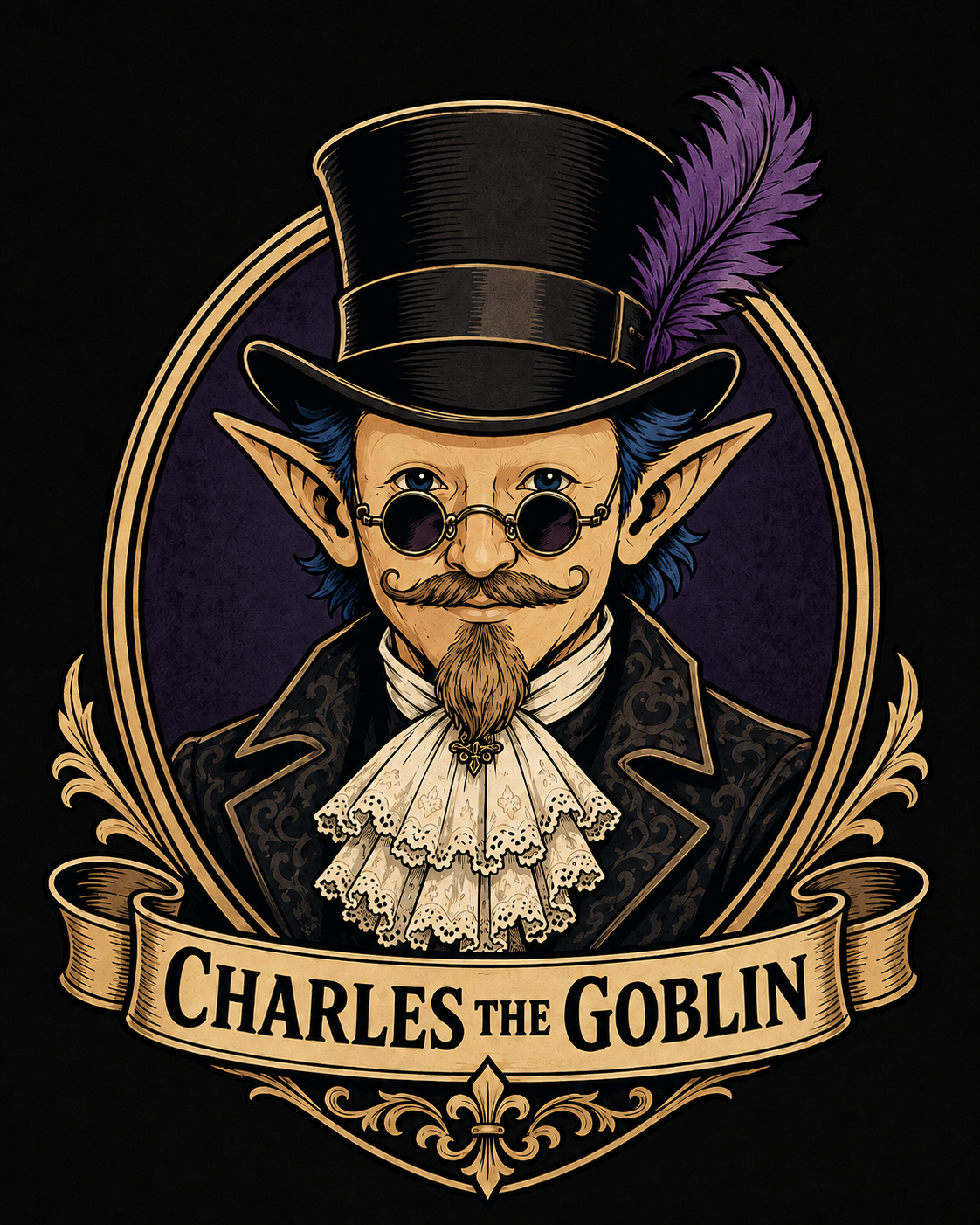
Chapter Thirty-Two:

And somewhere deep in the walls, something that hadn’t been there before paid very close attention.
The bakery alcove announced itself before they even reached it.
Warm air drifted down the corridor, rich with yeast, butter, sugar, and something citrusy that made Olivia’s tail sway despite herself. The moment they rounded the corner, the students collectively stopped, like a herd hitting an invisible fence.
The alcove was small, tiled in cream and pale blue, with a wide stone counter that was never empty for long. Fresh pastries appeared there the way good ideas do—unannounced, fully formed, and utterly convincing. Croissants. Sticky buns. Fruit tarts. Small loaves dusted with sugar. Everything steaming faintly, everything perfect.
Olivia raised a finger.“Rule one,” she said cheerfully. “Take what you like. Rule two: don’t be greedy. The alcove notices.”
One of the students laughed nervously. “The… alcove notices?”
Professor Collins adjusted his glasses, already peering intently at the counter. “Ah! Yes, spontaneous culinary manifestation tied to liminal labor myths—fascinating. Absolutely fascinating.”
A couple of students helped themselves, murmuring appreciation. One reached for a second pastry, hesitated, then glanced at Olivia, who gave a very polite but very pointed smile.
They chose differently.
Cameras came out. EM meters hummed. Someone waved a thermal imager at a still-warm cinnamon roll and gasped like they’d just discovered fire.
Then the ghost trap clicked.
Not loudly. Just a soft tick—tick.
The student holding it frowned. “Okay, that’s weird. It shouldn’t be reacting to baked goods.”
The device—a lunchbox-sized contraption of copper wire, scavenged electronics, and a jury-rigged vacuum core—gave a faint whine. A green LED flickered.
Olivia’s ears flattened for half a second.
“Is it broken?” another student asked.
“No,” the student replied slowly. “It’s… reacting. But there’s nothing here.”
Behind the counter, a low scritch sounded.
Olivia didn’t even turn around.“Grint,” she said mildly, “if you’re restocking cookies, now would be a lovely time to continue not being seen.”
Too late.
A small green head popped up behind the counter, eyes wide, cheeks already stuffed with something suspiciously chocolate-chip-shaped. Grint froze, one hand clutching a sack that read COOKIES (DO NOT TOUCH) in blocky marker.
Six students stared.
Grint stared back.
Time stretched.
Then Grint did what Grint always did under pressure.
He bolted.
There was a blur of green, a clatter of a dropped cookie sack, and the sound of tiny feet slapping tile as he vanished through a service door that absolutely had not been there a second ago.
Silence.
One cookie rolled to a stop at Olivia’s feet.
A student whispered, awed, “Was that…?”
Professor Collins’ eyes were shining. “A domestic liminal caretaker entity, likely bound by ritual labor and carbohydrate reinforcement—remarkable!”
The ghost trap spiked.
Hard.
The student holding it yelped as the device rattled in their hands. “Okay, okay, now it’s definitely reacting!”
“But not where Grint was,” another student said slowly. “It’s pointing—”
They all turned.
The needle wasn’t aimed at the counter.
It was aimed at the group.
More specifically… at the space just behind them.
Olivia stepped forward smoothly, tail swishing once.
“Alright!” she said brightly, scooping up the fallen cookie and placing it back on the counter. “Bakery alcove etiquette reminder: one pastry per person, no chasing staff, and absolutely no trapping anything that hasn’t signed a release form.”
The trap’s whine subsided as suddenly as it had begun.
The student frowned, puzzled. “Huh. It stopped.”
Professor Collins blinked, distracted by a tart that had appeared where the cookie sack had fallen. “Marvelous. Simply marvelous.”
The group relaxed, laughter bubbling up again, attention pulled back to sugar and theory and warm, comforting normalcy.
Only Olivia noticed that one student—standing a little apart now—had gone very still.
And only the trap noticed when that student moved again.
The green light flickered.
Once.
Then held steady.
Olivia made another mental note.
“Alright,” she said, clapping her hands lightly. “Next stop—the Archive observation window. Please don’t tap the glass. Bernard finds it… distracting.”
Somewhere in the walls, something ancient and amused agreed.
The stairs to the basement were narrow and softly lit, the walls shifting in color just enough to make it hard to tell whether they were painted or remembering being painted. Olivia led the way with practiced ease, one hand skimming the banister, tail swaying in an easy, confident rhythm.
About halfway down the corridor, the professor stopped short.
“Oh—oh my,” Professor Collins breathed.
To their left, set into the wall like a museum display, was the editing bay observation window.
For once, the blind was raised.
Beyond the thick glass lay a dim, cavernous room lit by dozens of small, hovering pools of light. Each glow resolved into a sprite—tiny, luminous, winged, and objectively adorable—seated at cluttered editing desks. Film strips hung like laundry lines overhead. Screens flickered with half-cut scenes, jump splices, and reversed frames.
And the noise.
“NO, NO, YOU CAN’T CUT ON THE BLINK, YOU ABSOLUTE WALNUT—”
“HEY! WHO MOVED MY TIMELINE? I HAD THAT LOCKED!”
“That dissolve makes it look like a SOAP OPERA, ARE YOU OUTTA YOUR MIND?”
The voices were high-pitched, nasal, and aggressively New York.
One sprite—pink, glowing, wearing what looked like a tiny tiara—stood on their chair, jabbing a glowing stylus at a screen.“I SWEAR TO GODS ABOVE AND BELOW, IF YOU TRIM ONE MORE FRAME OFF MY SEQUENCE I’M GONNA—”
“—GONNA WHAT? YOU’LL DO NOTHIN’, YOU GOT NO SENSE OF PACING!”
The students stared, mouths open.
One whispered, reverently, “They look like… fairy princesses.”
A sprite heard that and snapped their head toward the glass.“HEY! I HEARD THAT! THIS AIN’T PRINCESS WORK, THIS IS CRAFT, YA JERK!”
Another sprite didn’t even look up from their console.“IGNORE ‘EM. TOURISTS ALWAYS THINK WE’RE CUTE.”
“WE ARE NOT CUTE,” a third snarled. “WE ARE ARTISTS.”
Professor Collins had both hands pressed flat to the glass, eyes shining like a child at their first planetarium show.“Incredible. Living post-production entities. Manifest narrative editors. This explains the continuity stabilization—!”
One of the students slowly raised their camera… then thought better of it and lowered it again.
Olivia cleared her throat gently.“They’re… very good at what they do,” she said diplomatically. “And very territorial about it.”
As if on cue, a sprite hurled a glowing wad of something at another sprite’s head.
“THAT WAS MY TEA, YOU ASSHOLE!”
The professor laughed, delighted and slightly overwhelmed.“Marvelous. Simply marvelous.”
Olivia waited a respectful minute—long enough for the group to absorb the chaos—then clapped her hands once, softly.
“Alright,” she said. “Next stop.”
They moved on, the noise of the editing bay fading behind them, though the arguing continued unabated, echoing faintly down the hall like an eternal rant.
At the end of the corridor, the Archive observation window awaited—vast, dark, and impossibly deep. Rows upon rows of tapes, reels, and media formats that hadn’t existed in decades stretched beyond what perspective should allow.
And in the center of the space, something shifted.
Lights dimmed slightly. The air grew cooler.
A cluster of eyes opened.
A voice—warm, resonant, and unmistakably Welsh—flowed through the glass and into the hallway.
“Good morning,” Bernard said pleasantly. “You must be the seven I was told to expect.”
Every single person stopped.
Slowly, carefully, Olivia smiled.
“Everyone,” she said, gesturing toward the window, “this is Bernard. He runs the Archive.”
Bernard’s many eyes blinked in a way that felt, somehow, like a bow.
“And you,” he added kindly, “are most welcome. Please don’t tap the glass. It startles the older films.”
Somewhere in the group, the ghost trap let out a very small, very unhappy beep.
Bernard’s presentation began without fanfare.
The lights along the Archive wall dimmed, and the darkness beyond the glass rearranged itself. Ribbons of light unfurled in the air—diagrams, timelines, floating labels written in neat, looping script. Film reels rotated slowly, becoming planets. VHS tapes stacked themselves into impossible towers, then dissolved into flowing rivers of magnetic tape.
Bernard spoke gently, his voice resonating through the glass and the vents alike.
“The Archive is not a place so much as it is a process,” he explained. “A digestion, if you will. Stories enter. Meaning is extracted. Residue is catalogued. Harmful contradictions are… composted.”
Professor Collins was scribbling notes so fast his pen squeaked.
Several students waved EM meters and thermal cameras through the air. The devices responded enthusiastically—lights flashing, needles twitching—but never erratically. Almost politely.
When Bernard finished, the projections folded themselves away like obedient birds returning to roost.
“And now,” Bernard said, cheerfully, “questions are most welcome.”
A student raised a hand.“Why can’t we… you know… go inside?”
Bernard paused, several eyes blinking in sequence.
“Oh,” he said kindly. “Because you would die.”
A beat.
Professor Collins coughed. “Ah. Right. Of course.”
Bernard continued, as if explaining the weather.“The Archive is indexed to non-linear cognition, extra-temporal memory compression, and—how shall I put this—recursive selves. Humans entering the stacks tend to… unpack themselves. Permanently.”
Another student swallowed audibly.
A third raised a hand. “Are all the entities here… cooperative?”
Bernard smiled. You could hear it.
“Almost all,” he said. “Which brings me to a small matter of housekeeping.”
The temperature dropped a fraction.
Bernard’s gaze—many eyes narrowing just slightly—shifted away from the group and then back again.
“There is,” he said mildly, “one of you who is not a student.”
Silence.
Olivia felt every hair along her spine lift.
“I do not mean metaphorically,” Bernard added. “Nor administratively. I mean ontologically.”
One of the students laughed nervously. “Uh—what?”
Bernard tilted his head.
“The count has been inconsistent. Sometimes six. Sometimes seven. The extra presence is not reflected in your shadows, does not appear on three of your cameras, and causes mild distress to my indexing protocols.”
He looked directly at Olivia.
“Miss Olivia,” Bernard said gently, “would you like me to notify maintenance? There is something uncontained wandering freely.”
The word uncontained hit the room like a dropped plate.
The students began talking all at once.
“What does that mean?”“Is this part of the experiment?”“Professor?”“My EMF just spiked—”
And that was when the student with the ghost trap snapped.
“This is it,” they said, breathless, already yanking the device up from their shoulder. “This is exactly what it’s for.”
“WAIT—” Olivia started.
Too late.
The student thumbed a switch.
The ghost trap screamed to life, lights flaring, vents opening with a metallic clack as it locked onto the largest available anomaly on the readings—which, unfortunately, was Bernard.
The suction field slammed against the Archive glass.
The entire building objected.
The lights flickered. The floor thrummed. Somewhere far above, a door slammed itself shut in indignation.
Bernard recoiled—not in pain, but in profound offense.
“Oh dear,” he said, startled. “That is extremely rude.”
Olivia lunged for the student. “TURN IT OFF! NOW!”
But the damage was already done.
At the far edge of the group, the other student—the one Olivia hadn’t been able to quite remember being introduced—stiffened.
Their outline blurred.
“Nope,” they said, suddenly very clear and very not-panicked. “Not doing this.”
And then they bolted.
Not toward the stairs.
Up.
They shot straight through the ceiling like a silver streak, passing through concrete, wiring, and ductwork as if none of it existed, leaving behind a faint shimmer and the smell of ozone.
The ghost trap let out a strangled whine and shut itself down.
The room was dead silent.
Bernard slowly leaned forward until his eyes filled the glass.
“Well,” he said calmly. “That answers that.”
Olivia turned, hands on her knees, breathing hard.
Professor Collins stared upward, mouth open.
One student whispered, “Did… did they just fly?”
Bernard blinked.
“Yes,” he said. “They do that.”
He looked back to Olivia.
“You may wish,” he added politely, “to call maintenance now.”
Olivia moved first.
She stepped smoothly in front of the students, tail low but steady, palms out in a calming gesture that felt instinctive now rather than learned.
“Okay,” she said firmly, her voice carrying just enough authority to cut through the adrenaline. “Everyone take a breath. Nothing is attacking you. Nothing is hurt. And no one is in trouble—yet.”
That last word was pointed, and the student clutching the ghost trap froze.
Olivia gently but decisively took the device from their hands, turning it off fully and setting it on a nearby cart, well away from Bernard’s window. Bernard, for his part, had retreated slightly into the Archive’s depths, muttering to himself in Welsh about manners and the youth of today.
Olivia pulled out her phone—mostly out of habit.
She didn’t get to use it.
Footsteps echoed down the basement hall, unhurried, confident, accompanied by the faint scent of frost and old books.
Charles emerged from around the corner, cane tapping lightly against the floor, coat immaculate as ever.
Every conversation died instantly.
Half the students stared at him in slack-jawed silence, EM meters twitching wildly.
One whispered, “Is… is he a ghost?”
Another murmured, “Oh my god, look at the cuffs.”
Professor Collins adjusted his glasses for the third time in ten seconds, eyes flicking between Charles, the ceiling, and the faint patch of translucent slime still slowly sliding toward a vent.
Charles surveyed the scene in a single glance.
The powered-down ghost trap.The rattled students.Bernard’s many eyes watching from the dark.The residue on the ceiling.
He sighed—not deeply, but with the weary patience of someone who had absolutely expected this eventually.
“Well,” he said pleasantly, “that explains the spike in the wards.”
He looked directly at the student who had been holding the trap.
“I should inform you,” Charles continued mildly, “that bringing an unlicensed, improvised, nuclear-powered containment unit into my station is—how shall I put this—extremely discouraged.”
The student went pale.
Professor Collins finally found his voice. “Mr. Winthrop, I presume? There appears to have been an… additional participant?”
“Yes,” Charles said cheerfully. “There often is.”
He tapped his cane once. Frost crept briefly along the floor, then vanished.
“The entity you encountered is not hostile,” he added, glancing up at the ceiling. “Merely displaced, confused, and currently hiding in the pool area on the third floor. It has the narrative cohesion of a side character who wandered out of their own episode.”
Olivia blinked. “The pool?”
Charles nodded. “Warm water. Towels. A comforting echo. Honestly, I would’ve chosen the same.”
He turned his attention back to the group, smile still polite but eyes unmistakably sharp.
“As for the rest of you,” he said, “you are quite safe. Nothing here intends you harm. But I must insist we refrain from capturing my staff, my residents, or my building.”
A pause.
Then, softer, warmer:“Olivia, thank you for handling that so well.”
She felt a little taller at that.
Charles straightened, clapped his hands once, brisk and decisive.
“Right then. Maintenance will retrieve our unexpected guest shortly, Bernard will settle his nerves, and this tour will continue—without experimental hardware, yes?”
Every student nodded vigorously.
Professor Collins cleared his throat. “Of course. Strictly observational from here on.”
Charles smiled again, all charm restored.
“Splendid,” he said. “Now—shall we proceed? I believe next is the pool. And I do hate to keep a frightened apparition waiting.”